
Case Chronicle | Inheritance Notarization Stalled over “Parentage”: How Did Four Sets of Scattered Records Fully Establish the Right to Inherit?
Basic case information
| Case type | Inheritance dispute |
|---|---|
| Point of engagement | After inheritance notarization was blocked by identity and parentage evidence |
| Key evidence | Old and new household registration records, a police certificate, a forensic opinion and a village committee certificate |
| Outcome | The court issued a civil mediation statement approximately one and a half months after filing, followed by inheritance transfers of real estate and funds. |
I. The impasse: An inheritance path severed by household registration in another locality and a former name
When handling an inheritance, “proving that my father is my father” is often more than an internet joke: it is a real legal predicament faced by many families.
After an elder passed away, the client in this case went to arrange inheritance notarization while grieving, only to be stopped at the very first hurdle—he could not prove the parent-child relationship.
The notary office applied extremely strict scrutiny, and the client’s circumstances happened to hit every historical “minefield”: years earlier, he had moved his household registration out of his hometown and registered in another locality. More difficult still, the name recorded in the early household registration register differed from the name he later used when registering in that other locality.
If the household registration records could not be matched to the person, there was no basis for establishing parentage. Although the client held several scattered supporting documents, the notary shook their head upon reviewing them. The inheritance notarization had reached a complete impasse.
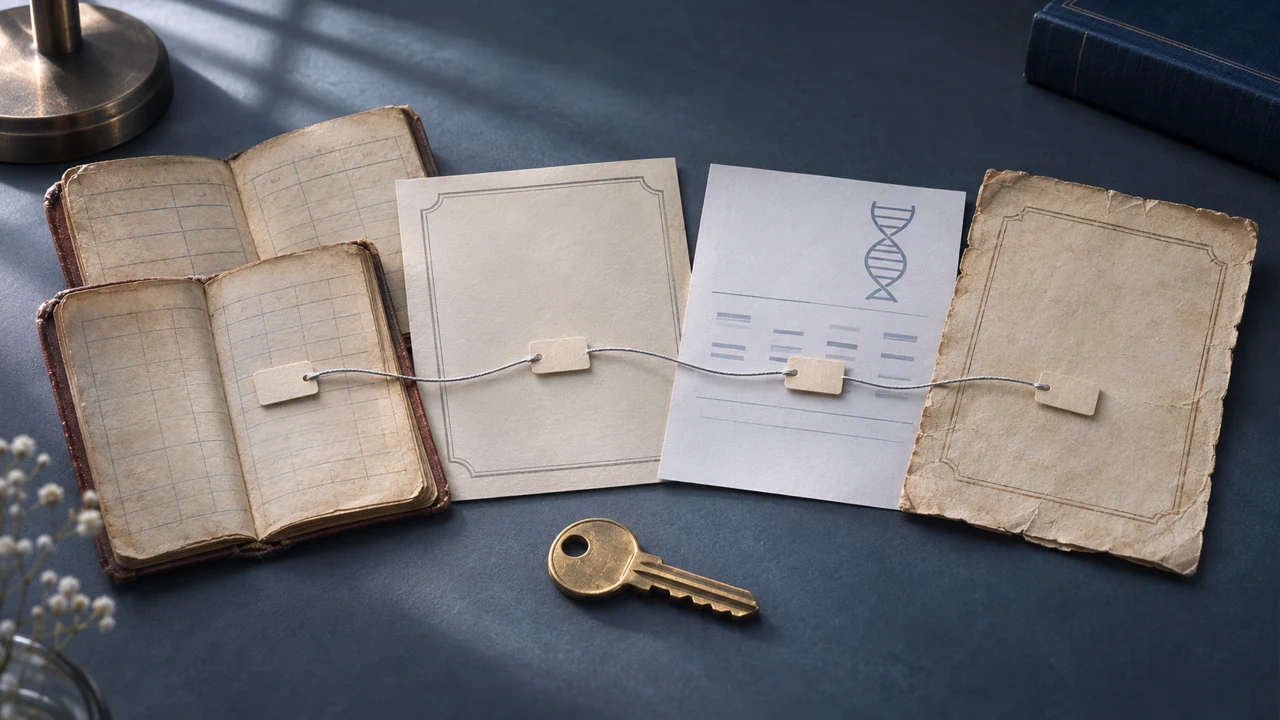
With no other way forward, the client came to me for help. On my desk were four sets of materials that appeared disconnected and even somewhat contradictory: several old and new household registration booklets, a certification letter issued by a police station, a forensic opinion, and a certificate issued by a village committee.
Taken separately, none of these four sets of materials was enough to settle the right to inherit directly. The core of representation in this case is finding a way to make these silent papers “speak” and assemble them into an unassailable chain of evidence.
II. Following the trail: Matching migration records to solve the identity puzzle of “I am who I say I am”
When dealing with difficult questions about historical family relationships, the first step is never to prove “parentage.” It is first necessary to establish “identity equivalence”—that the records refer to the same person.
I placed the client’s household registration page recording his move out of his place of origin beside the page recording his move into the other locality, and plotted a timeline by year. Although the old registration used his former name and the new registration used his current name, any lawful household registration transfer necessarily leaves a paper trail.
By comparing the records word for word, I found two “hard links” hidden in the details:
- The birth information matched exactly: the date and place of birth in the two household registration records were identical.
- The migration document numbers interlocked: the permit-to-move/migration-certificate number on the stamped page recording the move out of his place of origin matched exactly the number at the bottom of the receiving police station’s move-in registration entry.
I then brought the police station’s certification letter into the evidence chain. This letter provided specific official confirmation linking the former and current names. Through three-way corroboration—“timeline + register reference numbers + police station certificate”—we first conclusively ruled out, in legal terms, the possibility of two people sharing the same name or of impersonation, firmly establishing that “the person he was then” and “the person he is now” were one and the same.
III. Getting to the substance: Placing the forensic conclusion and village committee certificate precisely where they belonged
Once “I am who I say I am” had been resolved, the next issue was “parentage.”
The family provided a forensic opinion concerning DNA kinship/parentage testing. To a layperson, surely a scientific test settles everything? In legal practice, however, a forensic opinion can establish only a “biological blood relationship,” while inheritance rights sometimes also involve complex social relationships of upbringing, such as the common customary practice of “adoption into another family” or de facto adoption.
I placed the forensic opinion back into the timeline, carefully checking the source of the samples and the specific people covered by the testing, and confirmed that its conclusion pointed precisely to a direct biological parent-child relationship between the client and the deceased.
I then inserted the final piece of the puzzle—the village committee certificate.
Often, if a certificate from a grassroots organization states only that “A is B’s son,” judicial authorities will not accept it directly because it lacks a stated basis. I guided the family in clarifying the period and scope covered by the village committee’s certificate, using it to corroborate the objective historical facts that the client had lived with and been raised by the deceased while in his place of origin.
At this point, identity verification, biological relationship testing and historical facts of upbringing fitted together seamlessly, each performing its own role.
IV. The breakthrough: From blocked notarization to court mediation, a swift conclusion in one and a half months
In notarial practice, to guard against the risk of issuing an incorrect certificate, notary offices often take an extremely cautious approach to complex family relationships involving former-name changes and household registration transfers across provinces many years earlier, and are reluctant to issue a notarial certificate readily.
With the notarial route blocked, I decisively advised the client to change course: bring an inheritance dispute before the people’s court and establish the rights through a judicial document.
After the case was formally filed, I compiled and submitted to the court, as the core evidence, the clearly organized “Chronological Comparison Table of Identity and Parentage” together with the originals of the four sets of evidence. On that basis, I actively communicated with the judge and any other potentially involved statutory heirs.
Because the evidence chain had been organized so thoroughly as to be unassailable—“who was who” was clear at a glance, “parentage” was scientifically established, and “facts of upbringing” were corroborated at the grassroots level—an inheritance dispute that might otherwise have become a prolonged tug-of-war had no room left for contention.
Only approximately one and a half months after filing, the court brought the parties to an agreement and formally issued a Civil Mediation Statement.
With this legally enforceable judicial document, the client successfully completed the inheritance transfers of the real estate and funds.
Case notes
When handling cases to establish inheritance rights arising from old records and household registration transfers across regions, a lawyer must be more than a “document courier” and must instead become an “architect of the evidence chain”:
1. Break down the isolation of individual documents and establish a “timeline review method”
Household registration booklets, certification letters and forensic reports are scattered across different periods. They must be connected chronologically through “birth—living together—moving out—moving in—name change.” Only by identifying which document establishes “the same identity,” which establishes “the blood relationship,” and which establishes “the facts of upbringing” can the evidence work together.
2. Keep a close eye on the “migration numbers” in household registration registers
When proving that “the former name refers to the same person,” do not rely solely on a certificate issued by the police station, which may sometimes refuse to issue one because so much time has passed. Cross-checking the permit-to-move certificate numbers, dates of birth and native-place details on the move-out and move-in household registration pages often produces the objective, hard evidence that courts value most.
3. Watch for legal conflicts between “adoption into another family” and “blood relationship”
When reading village committee certificates or historical archives, any wording such as “adopted into another family” or “raised by so-and-so” requires close attention. Whether an adoption relationship is legally recognized, and whether it affects the client’s eligibility to inherit from a particular deceased person, must be assessed in light of when the relationship arose and the rules applicable at that time. Clarifying the objective facts of what happened at the time and ruling out disputes over inheritance eligibility in advance is the essential foundation for achieving a swift conclusion through court mediation.